
Oct 22, 2026 · In the News · 7 min read
The USL Rebrand: Right Moment, Wrong Accent
My reaction to the USL's new United for Soccer identity, and why a league built on promotion and relegation should lean into being American instead of borrowing England's accent.
The USL unveiled its new brand identity this week. It’s built around “United for Soccer,” it gives all of its leagues one consistent look, and it introduces the first official logo for USL Premier, the Division One league it plans to launch in 2028.
My first reaction was honestly: do they really need this? The USL has bigger problems than its logo. But the more I think about it, the more I understand it. Moving to promotion and relegation is a massive shift, the first time a professional league in the US will do it, and a rebrand is a way of planting a flag. It marks a pivotal moment in the USL’s history, and I get wanting the look to match the ambition.
My issue isn’t the logo. It’s what the USL is choosing to be.
A Division One league that doesn’t act like one
The USL has been telling everyone it’s building a Division One league since early 2025, when it announced plans for a new top-flight men’s league to rival MLS. Its own promotion and relegation page lists USL Premier as Division One. (To be fair, US Soccer still has to officially sanction it, and the inaugural clubs haven’t been announced yet.)
But being Division One is about more than a label, and right now the USL doesn’t act like one.
Clubs fold regularly. North Carolina FC shut down after the 2025 season, and the players’ union said it was the 12th USL Championship club to fold in a decade. South Georgia Tormenta suspended operations two weeks before the 2026 League One season started. Spokane Zephyr folded out of the Super League in May, and that’s the USL’s women’s Division One league.
Attendance is poor in a lot of markets. According to Backheeled’s USL attendance tracker, the USL Championship averaged around 5,000 fans a game through mid-September, down almost 9% from last year. League One averaged under 3,000. The bottom of the Championship is rough: Miami FC averaged 924, Loudoun United 1,625, Sporting JAX 1,907 and Brooklyn FC 2,013.
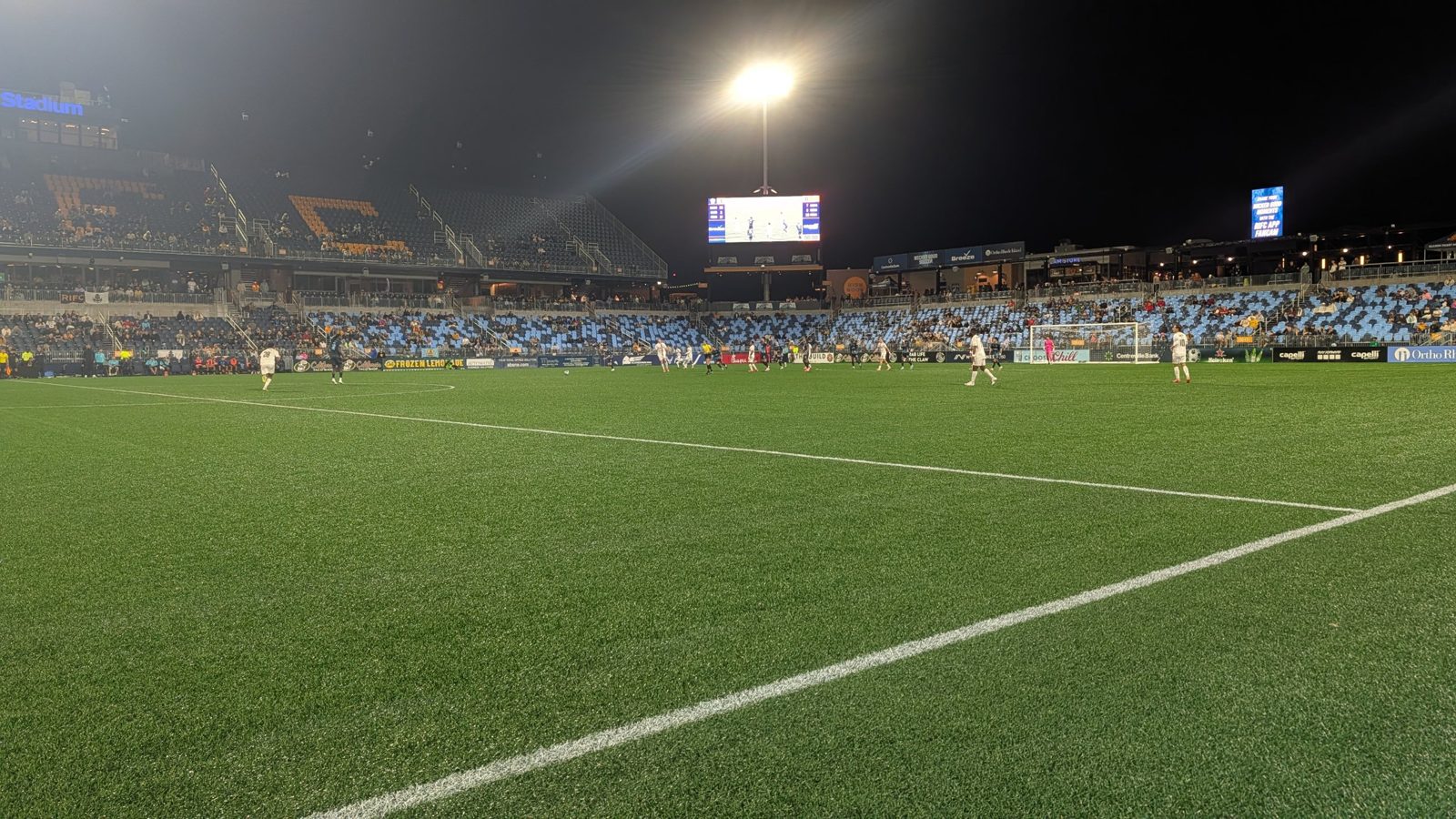 The night Rhode Island FC clinched a playoff spot: a Wednesday evening, decent weather, and a lot of empty seats.
And the presentation of the product in some markets is some of the worst I’ve ever experienced. Last year I watched Rhode Island FC play Miami FC in Miami, and the “stadium” was a joke for that level of soccer. It felt like the game was being played in a parking lot. This year it was Rhode Island at Brooklyn FC, in a minor league baseball stadium. The camera angles were low, there were two giant nets right in front of the camera, and a carnival was going on in the background. The nets threw the picture off too (blacks were really black, whites were really white), and nothing looked clear. It was a terrible viewing experience, and that’s the product a new fan sees first.
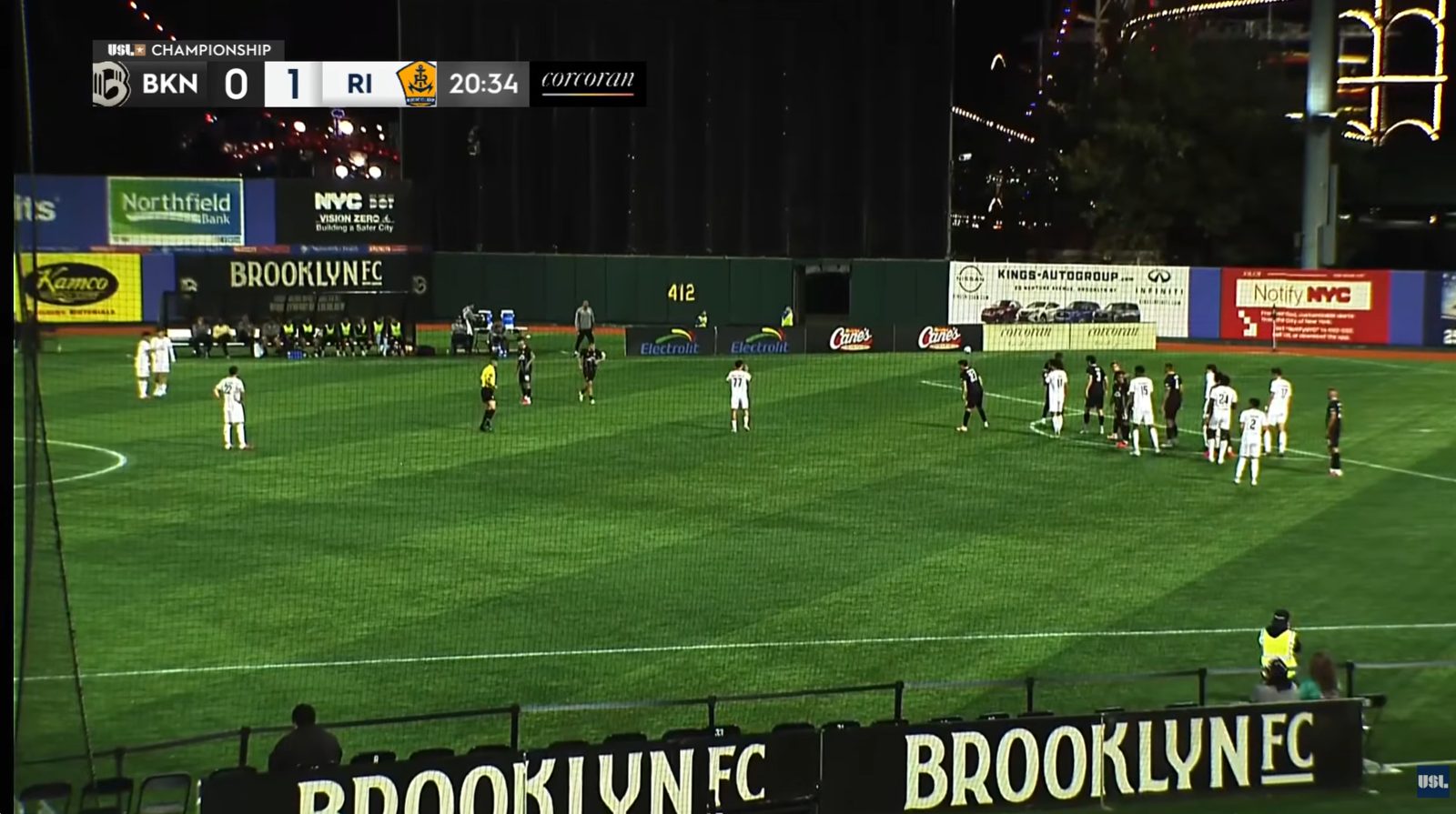 The Brooklyn FC vs Rhode Island FC broadcast: a low camera angle, netting in front of the lens and a carnival behind the outfield wall.
Temu England
This is where I get more critical. The USL is an American league trying very hard to be the English pyramid, and it’s even copying the names. USL Premier, USL Championship, League One. If you ask the average American sports fan which division “League One” is, I’m betting the majority will not say the third division.
It goes deeper than the league names. I went through every men’s professional club in the USL Championship and League One this season (42 of them). Twenty are named with nothing but a place and an FC, SC, United, City, Athletic, Sporting or Union tag (Brooklyn FC, Louisville City FC, New Mexico United, Hartford Athletic, Union Omaha, Athletic Club Boise). Another 14 have a real nickname but still tack an FC or SC on the end (El Paso Locomotive FC, Pittsburgh Riverhounds SC, Oakland Roots SC). That’s 34 out of 42 clubs, 81%, carrying a European naming convention.
Only eight are named the way American teams are named: Tampa Bay Rowdies, Charleston Battery, Indy Eleven, Charlotte Independence, New York Cosmos, Portland Hearts of Pine, Richmond Kickers and Sarasota Paradise.
And the problem with calling yourself FC is that most of these teams aren’t proper football clubs. They don’t have extensive youth programs, and they aren’t a club you can join. The word “club” used to mean something. Now it’s becoming another way to say “professional team,” because every new franchise with zero existing ties to its community gets to call itself one.
And it’s not just the pros. USL League Two, the pre-professional tier, has 158 clubs this season, and 132 of them (84%) follow the same pattern. There’s even a Santafé Wanderers FC and a Toledo Villa FC. Only 26 have names like the Laredo Heat, Long Island Rough Riders or Little Rock Rangers.
| League | Clubs | European style | Nickname plus FC/SC | American style | European convention |
|---|---|---|---|---|---|
| Championship | 25 | 14 | 8 | 3 | 88% |
| League One | 17 | 6 | 6 | 5 | 71% |
| League Two | 158 | 87 | 45 | 26 | 84% |
The USL has to know who attends its games. Yes, there will be dedicated and knowledgeable soccer fans (I’m one of them). But the primary demographic that pays the bills is casual sports fans bringing their families to a fun, family friendly event. Those fans don’t care that a name sounds like it belongs in the Football League. They care whether it’s fun to say, fun to wear and easy to rally around. They want something familiar.
The opening MLS left behind
The timing makes this more frustrating. MLS is losing the plot: it went all in on Messi, and putting everything behind Apple TV has killed discoverability. You don’t stumble onto an MLS match anymore. And don’t even try asking a bartender to put the MLS match on. It’ll be a combo of “Who?” and “I don’t think we have Apple TV.”
That puts the USL in a unique position to be the American soccer league. The league for your town, your family and your Saturday night. Instead, they said “we’ll be the Temu England pyramid.”
The changes I’d make are all about being more relatable to casual sports fans. Embrace being an American league. Use American names, for the leagues and for the clubs, that a casual fan understands the second they hear them. Keep the soccer, lose the accent.
The part they got right
For all of that, the USL is solving the right problem. Promotion and relegation is what will make lower league games relevant and entertaining for those fan bases.
Compare it to how minor league baseball and hockey teams market themselves. It’s one-off promotions, come see the stars of the future, and deep down everyone knows the result of the game doesn’t matter. With promotion and relegation, the result matters every week, for every club.
It will take some explaining for casual fans to understand. And honestly, I think it will be popular, because it’s the American dream. Start at the bottom, rise up, and control your own destiny. The USL already has the most American story in sports. I just wish its brand spoke the same language.
I’ll have another post soon on the USL’s content strategy, what I think its challenges are and how I’d solve them.
This post was produced with a Claude repurposing agentic workflow I built: I write down my raw thoughts, and AI helps turn them into this post, my social posts and the visuals. I review and edit everything before it goes live. Curious how it works? Ask me how I built it!